
If you use AI Assistant tools like Claude, Filevine AI, or Clio Work for broad, comprehensive tasks such as generating medical chronologies or listing all treatments and pre-existing conditions, you'll quickly notice a troubling pattern: they miss critical details. Yet, if you ask a focused, pointed question about a missed detail such as “did the patient report neck pain prior to Dec 5, 2025?”, it will provide an accurate answer.
This isn't a random glitch, but a direct result of an architectural tradeoff built into chat-based AI systems.
Understanding which tool fits which task allows legal professionals to get the most out of modern AI and focus on what matters most: winning more cases.
The Technical Bottleneck: Context Window and Semantic Search
Every AI model has a limit on how much text it can analyze at a single moment; referred to as its context window. A 300-page medical file far exceeds this limit. To work within the size limit, the AI system does not read the full document when you ask a question. Instead, it only pulls snippets from the original text using a semantic index to return all words with similar meanings, not just exact matches.
For example, looking up “neck pain” in the semantic index will return not just occurrences of neck and/or pain, but also phrases with vaguely similar meanings, such as "inflamed larynx". Such result typically provide sufficient context to answer focused questions like “Did the patient report neck pain?”.
Such a design is referred to as Retrieval-Augmented Generation (RAG) and it forms the basis of all chat-based AI systems.
However, when you give a broad command like “list all pre-existing conditions,” the search index returns snippets containing matches for “pre-existing condition.” If a doctor wrote “Patient had a 2018 lumbar discectomy” without any words vaguely similar to “pre-existing condition,” that section is skipped entirely.
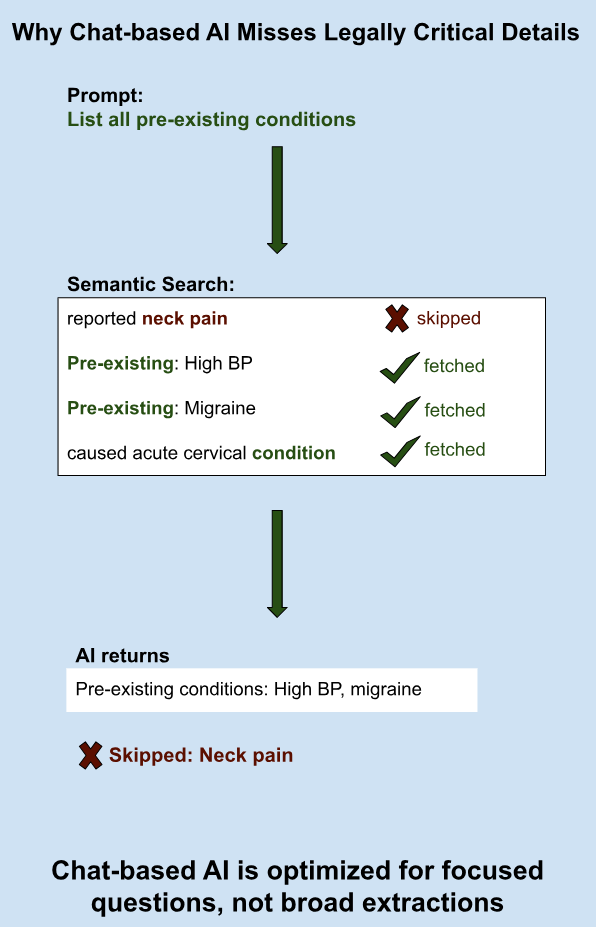
All chat/prompt based AI platforms including Claude, ChatGPT, including legal specific tools such as Clio Work and Filevine OS can miss details as it is an inherent design tradeoff. Vendors that provide Chat/Prompt based systems do so because the system is quick and easy to build, not because it solves the requirements of a personal injury firm.
The Solution: Full-Text Processing and Consolidation
To ensure that broad tasks such as medical extractions are thorough, the system must process the document through a fundamentally different workflow:
- Full Text processing: Instead of fetching selective snippets, the AI must process the full page text. To stay within the context window limits, larger files must be broken into chunks to be processed one-at-a-time.
- Consolidation: The findings from every chunk must be aggregated to eliminate duplicates while using strict program guardrails so that facts are never lost in the final summary.
Matching the Tool to the Legal Task
Use Broad Chat Systems (Claude, NotebookLM, and CMS integrated chat AI such as Clio Work) for: Quick pointed questions, drafting client correspondence, summarizing single records, or status updates.
Use Purpose-Built Legal Extraction Engines (such as AttorneyAide) for: Comprehensive medical chronologies, exhaustive pre-existing condition audits, and full demand package preparation.
Understanding which tool fits which task allows legal professionals to get the most out of modern AI and focus on what matters most: winning more cases.