
AI is widely discussed in the legal profession as a disruptive force that will reduce the need for lawyers and paralegals. But evidence from law firms adopting AI shows that the opposite is happening. Firms using AI tools are reporting increased revenue, a hiring surge for tech-fluent staff, and the ability to monetize cases they would have previously rejected.
This is a well-known phenomenon in economics called Jevons Paradox or Jevons Effect. Understanding this principle is the single most important factor for attorneys and paralegals looking to navigate the next decade of their career.
What is Jevons Paradox?
The early Newcomen steam engine converted only about 0.5% of coal's energy into useful work, while modern steam turbines can exceed 60% efficiency. Given this dramatic improvement, far less coal is needed to generate the same amount of energy. You might therefore expect coal consumption to decrease. Instead, the opposite happened. Global coal consumption increased dramatically.
Cheap, abundant energy didn't just make existing activities more efficient, it created entirely new applications such as railroads, mechanized manufacturing, and electricity generation, helping drive the Industrial Revolution.
In 1865, economist William Stanley Jevons was the first to observe this counterintuitive trend. The phenomenon became known as Jevons Paradox and it has repeatedly reshaped entire industries:
When technological progress makes the use of a resource more efficient, the overall demand for that resource increases instead of decreasing.
The resource under discussion in this article is legal professionals such as attorneys and paralegals. We explore how the ongoing trends make them more valuable.
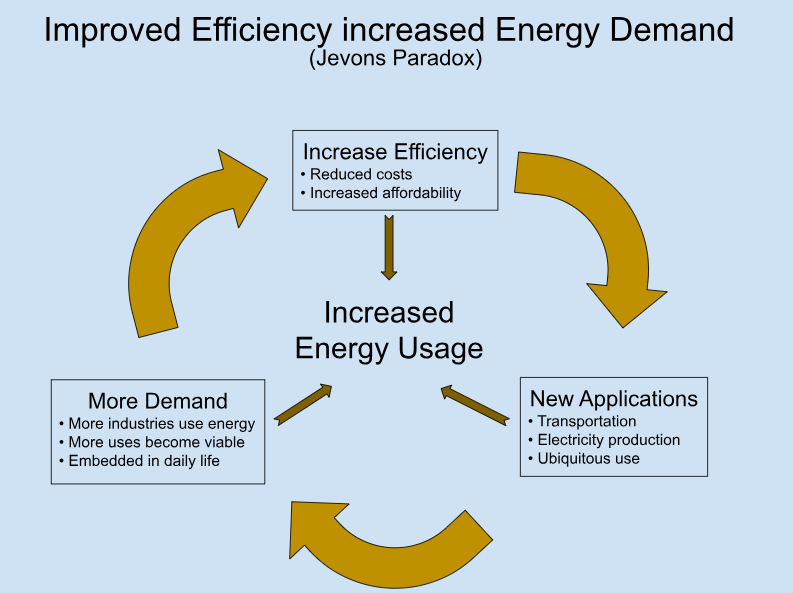
Dropping energy costs unlock new applications for energy and increase overall demand for energy.
More Historical Examples of Jevons Paradox
Software
Early programmers wrote instructions directly in machine code using zeros and ones. The invention of compilers and high-level languages drastically increased programmer productivity. A single line of code replaced 100+ lines of machine instructions.
Instead of eliminating programmers, productivity gains enabled the creation of a whole new set of applications including the internet, smartphones, and AI. Today the world employs millions more software engineers than existed during the era of machine instructions.
Agriculture
The Green Revolution dramatically improved crop yields through fertilizer, irrigation, and plant genetics. Similarly, the Cotton gin increased cotton processing efficiency by roughly fifty times. These innovations made agricultural goods cheaper and dramatically expanded the market by massively increasing consumption.
Why the Legal Profession Is Perfectly Positioned for Jevons Paradox
For Jevons paradox to occur, two conditions must exist:
- technological improvements dramatically lower costs
- there is massive suppressed demand caused by high costs
Legal services meet both conditions perfectly.
Condition 1: AI Is Dramatically Reducing Legal Costs
Artificial intelligence is rapidly improving productivity in areas such as:
- medical records organization
- document review and drafting
- legal research
- contract analysis
- discovery processing
Work that previously required dozens of billable hours can now often be completed in minutes or hours. The largest efficiency gains appear in documentation-heavy practices, including:
- personal injury
- mass torts
- insurance litigation
- mergers and acquisitions
- regulatory compliance
These advancements free up legal professionals from tedious tasks and instead allow them to focus on higher value tasks such as analysis, case strategy, and client relationship management.
Condition 2: There Is Massive Latent Demand for Legal Services
Legal services remain expensive and inaccessible for most people. As a result, individuals and businesses frequently avoid lawyers until problems escalate.
Research from the Legal Services Corporation has consistently found that the majority of civil legal problems experienced by Americans receive little or no legal assistance. Similarly, studies by the American Bar Association have long documented a gap in access to justice.
Other examples include:
- Personal injury firms decline up to 90% of potential cases because the cost of obtaining medical records, reviewing documentation, hiring experts, and preparing litigation makes smaller claims economically impractical.
- Everyday interactions are devoid of any legal frameworks instead relying on social expectations
- People rarely consult lawyers before signing everyday contracts
- Many small claims never become lawsuits
- Businesses often perform minimal legal due diligence due to cost
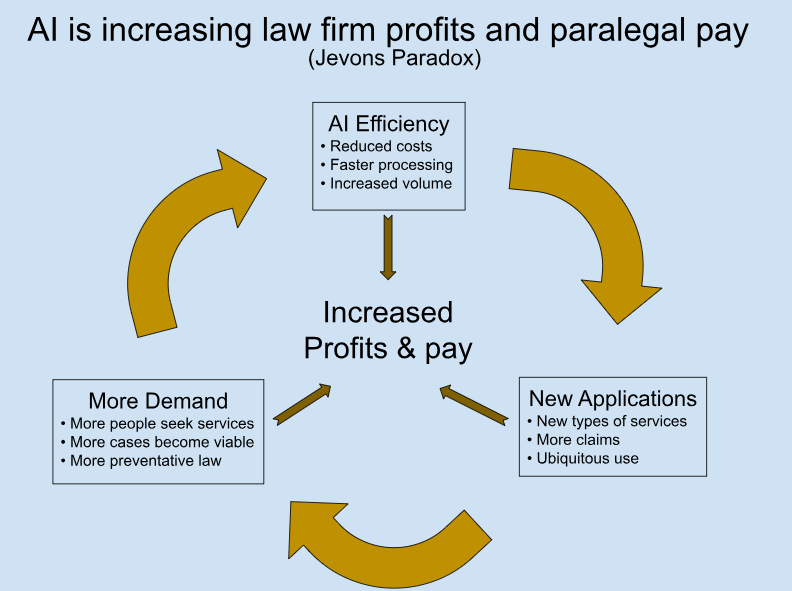
Dropping legal costs unlock new applications for legal work and increase demand for law professionals.
The Rise of the 10x Paralegal
One of the most overlooked consequences of legal AI is its impact on support staff. AI gives skilled support staff superpowers. They can now:
- organize and analyse thousands of pages of records
- produce litigation-ready chronologies rapidly
- support more cases simultaneously
- provide higher-level legal insight
This creates a new category of professional sometimes described informally as the 10x paralegal. These professionals combine their legal expertise with technology fluency. Whereas hiring a good paralegal might be a gamble for a law firm, hiring a 10x paralegal is a no-brainer. Demand for these roles is already rising, particularly among firms that are aggressively adopting legal AI tools.
Why are there widespread claims of AI making attorneys and paralegals obsolete?
If AI is so good for the profession, why are there widespread claims that it will make attorneys and paralegals obsolete? This narrative is driven by three fundamental misunderstandings:
- Over-Zealous Marketing: Over-the-top claims get more views, clicks, and shares. They are also used to justify inflated evaluations for AI companies to VCs.
- The Lump of Labor Fallacy: Many analysts assume there is a fixed amount of legal work to be done. They think if AI does half the work, we need half the people. Jevons Paradox proves that as work gets easier, the amount of work actually expands to fill the new capacity.
- The Complexity Tax: As AI makes simple tasks easier, the legal landscape becomes more complex, not less. Increased documentation leads to more discovery; more contracts lead to more compliance needs.
Multiple past technologies including computers, e-filing, and case management software all made such claims. The legal profession has only grown from all these improvements.
Practical Guidelines for Legal Professionals
Understanding Jevons paradox provides practical guidelines for attorneys and paralegals navigating the AI transition.
Choose Tools That Produce Measurable Efficiency
Not all legal AI products deliver meaningful improvements. Evaluate tools based on clear, quantifiable outcomes such as total time, effort, and cost saved, and increased revenue and case capacity.
Be cautious of vendors that emphasize prestige clients, large funding announcements, or vague unmeasurable performance claims instead of results. Legal technology should improve measurable outcomes, not just generate marketing excitement.
Align Incentives Within the Firm
In some firms, billing structures unintentionally discourage efficiency. When compensation is strictly tied to billable hours, technology adoption may slow.
Forward-thinking firms increasingly align incentives around case outcomes, firm profitability, productivity improvements, and value delivered to clients. Clients care about results, not the number of hours required to achieve them.
Focus on Market Expansion, Not Just Cost Reduction
The firms that benefit most from AI will not simply reduce costs. They will expand services. Lower costs allow firms to serve previously ignored market segments.
Opportunities include increased case intake, proactive preventative legal services, client education, compliance consulting, safety and liability audits, and contract management.
What Happens When Legal Costs Drop
When AI reduces legal costs, more cases suddenly become viable and entirely new applications emerge.
The legal market is shifting from the narrow tip of high-stakes litigation to a broad and ubiquitous utility model.
Preventative Law Becomes Normal
Most people see a doctor annually. Very few people consult a lawyer regularly. But when legal advice becomes affordable and accessible, preventative legal practices may become routine: annual legal check-ins, proactive contract review, liability audits, wills, estate planning, health care directives, guardianship planning, risk assessments, and services for small businesses and individuals.
Smaller Disputes Become Economically Viable
When litigation costs drop, smaller claims become worth pursuing, more plaintiffs can afford representation, and law firms can accept cases previously considered too small.
Legal Documentation Expands Dramatically
Many social and business interactions currently rely on informal expectations. Lower legal costs will encourage formalization of agreements: clearer contracts, defined liability expectations, and documented risk disclosures.
AI is expanding the total consumption of law. Instead of a service only used during crises it becomes a routinely consumed utility similar to healthcare, accounting, or electricity.
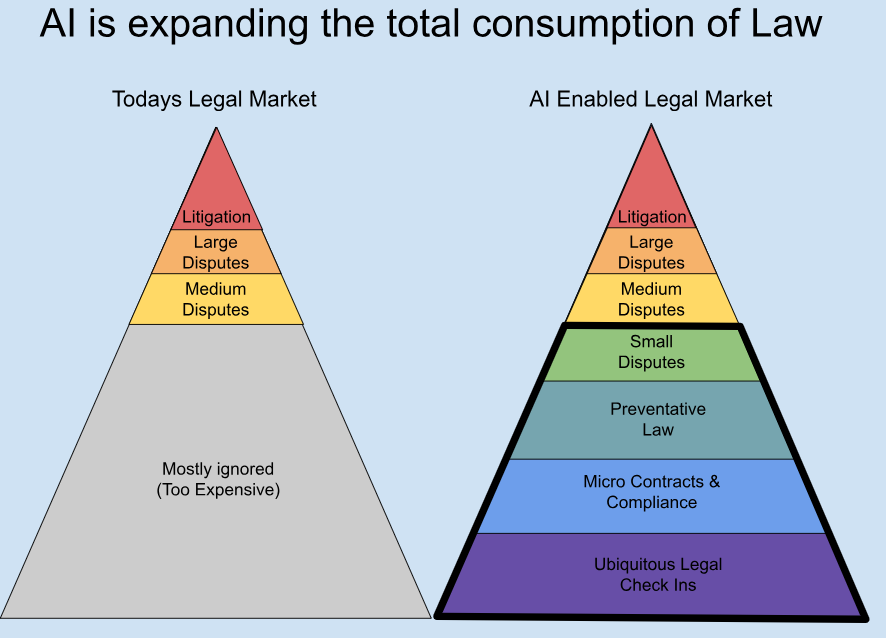
The legal market is moving from the narrow tip of high-stakes litigation to a broad and ubiquitous utility model.
When Law Becomes Infrastructure
Electricity provides a useful analogy. In the late nineteenth century, electricity was expensive and rare. Anything other than specialized industrial use was prohibitively expensive. Few people imagined it would eventually power nearly every home, device, and business activity.
Over time, falling costs and improved distribution transformed electricity into a ubiquitous utility. Today it is so embedded in daily life that most people only notice it when it stops working. Artificial intelligence may have a similar effect on legal services.
Currently, individuals and businesses typically consult lawyers only when the stakes justify the cost—during litigation, major transactions, or regulatory crises.
As AI reduces the cost of analyzing documents, contracts, and regulations, legal guidance becomes embedded into everyday life. Law begins to function less like an emergency service and more like infrastructure. Just as modern society consumes enormous amounts of electricity without thinking about it, a future economy may consume vastly more legal analysis, compliance verification, and contractual validation than it does today.
This possibility reinforces the central insight of Jevons Paradox: efficiency does not necessarily reduce consumption. It often makes widespread adoption possible. For attorneys and paralegals who learn to work with AI rather than against it, the coming decade may represent one of the most significant opportunities in the history of the legal profession.
Good attorneys and paralegals are worth their weight in gold; they are about to become even more valuable.